

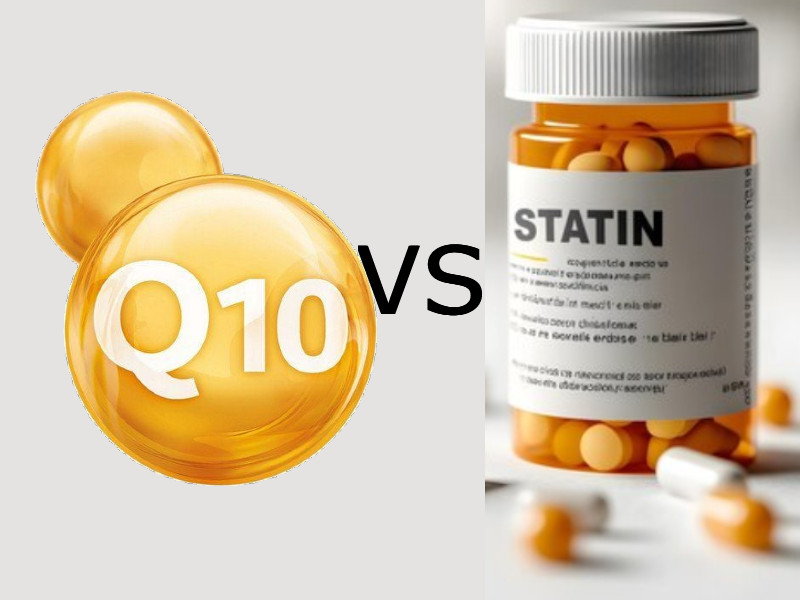
Taking a statin medication will lower the level of Coenzyme Q10 in the body. Statins inhibit the action of the HMG-CoA-reductase enzyme. HMG-CoA-reductase is involved in the bio-synthesis of both cholesterol and CoQ10. In blocking the bio-synthesis of cholesterol, the enzyme also blocks the bio-synthesis of CoQ10 [Okuyama 2015].

A meta-analysis published in the Journal of the American Heart Association shows that CoQ10 supplements can ameliorate statin-associated muscle pain, weakness, cramp, and tiredness.
Note: The statin medications do not totally block the bio-synthesis of cholesterol and CoQ10. However, they do block the bio-synthesis of both to a considerable extent. Studies show that statin medications lower CoQ10 levels in the serum and in muscle tissue. In so blocking the bio-synthesis of CoQ10, the statins can induce mitochondrial dysfunction [Deichmann 2010].
Optimal bio-synthesis of CoQ10 is necessary for mitochondrial ATP energy production. CoQ10 is also important as a powerful lipid-soluble antioxidant and is a known anti-inflammatory agent [Dabbaghi Varnousfaderani 2023]. Analysis of the data from the KiSel-10 study has shown that combined CoQ10 and selenium supplementation is associated with significant reductions in biomarkers of oxidative stress and systemic inflammation [Alehagen 2022].
Statin-Associated Muscle Pain and Weakness
In a 2018 review, Qu et al investigated the effect of statin medications on circulating levels of CoQ10. They analyzed the data from 12 RCTs with a total of 1,776 participants. Compared with placebo, statin medications resulted in a significant reduction of circulating CoQ10. Both lipophilic statins and hydrophilic statins decreased circulating CoQ10 [Qu 2018 Nov].
The reduction in blood Coenzyme Q10 status may explain statin-associated muscle symptoms, e.g., muscle pain and muscle weakness. CoQ10 supplementation is complementary approach to medication with statins [Niazi 2020].
In a separate 2018 meta-analysis of 12 RCTs with a total of 575 patients enrolled – 294 patients in the CoQ10 supplementation group and 281 in the placebo group – Qu et al observed that CoQ10 supplementation ameliorated statin-associated muscle symptoms: muscle pain, muscle weakness, muscle cramp, and muscle tiredness [Qu 2018 Oct].
From the Journal of the American College of Cardiology
Writing in a 2021 JACC Focus Seminar paper, Raizner & Quinones asserted that the evidence from relevant meta-analyses supports the use of Coenzyme Q10 supplementation in cases of statin-associated muscle symptoms. Moreover, they argued that statin-related CoQ10 deficiency may play a role in patients with diastolic heart failure [Raizner 2021].
In an earlier article, Raizner, a cardiologist at Houston Methodist Debakey Heart and Vascular Center, Houston Methodist Hospital, Houston, Texas, stated that CoQ10 has biological properties that may be beneficial in two clinical settings [Raizner 2019]:
- statin-associated myopathy syndrome
- congestive heart failure
Statin Withdrawal and CoQ10 Supplementation
Langsjoen et al identified 142 heart failure patients on long-term statin therapy. Langsjoen discontinued the patients’ statin therapy and simultaneously started the patients on Coenzyme Q10 supplementation (average dosage = 300 mg/day). Langsjoen knew, of course, about the outcomes of the Q-Symbio study. That study showed that adjuvant treatment of heart failure patients with 3 times 100 mg daily for two years improved symptoms and survival [Mortensen 2014].
After 2.8 years of the discontinued statin treatment and the initiated Coenzyme Q10 supplementation, Langsjoen observed the following improvements in many of the heart failure patients [Langsjoen 2019]:
- improved NYHA functional class
- improved ejection fraction in HRrEF patients
- normalized diastolic function in HRpEF patients
- reduced fatigue, muscle weakness, memory loss, and peripheral neuropathy improved mortality rates
Langsjoen concluded that long-term statin therapy may result in statin-associated cardiomyopathy that will respond safely to discontinuation of the statin treatment and commencement of the Coenzyme Q10 supplementation. Moreover, statin-associated cardiomyopathy may be a contributing factor to the current increasing prevalence of heart failure with preserved ejection fraction [Langsjoen 2019].
Conclusion: Statin Medications and CoQ10 Supplements
Statin medications lower CoQ10 levels in serum and muscle tissue.
Sub-optimal and deficient CoQ10 levels increase the risk of mitochondrial dysfunction.
CoQ10 supplementation may help to improve mitochondrial function and to provide antioxidant and anti-inflammatory protection.
CoQ10 supplementation is safe, effective, and affordable.
CoQ10 supplementation does not affect the efficacy of statin medications.
CoQ10 supplements differ from one another in quality – it is imperative to find a CoQ10 supplement with documented absorption and bioavailability.
Sources
Alehagen U et al. Improved cardiovascular health by supplementation with selenium and coenzyme Q10: applying structural equation modelling (SEM) to clinical outcomes and biomarkers to explore underlying mechanisms in a prospective randomized double-blind placebo-controlled intervention project in Sweden. Eur J Nutr. 2022 Sep;61(6):3135-3148.
Dabbaghi Varnousfaderani S et al. Alleviating effects of coenzyme Q10 supplements on biomarkers of inflammation and oxidative stress: results from an umbrella meta-analysis. Front Pharmacol. 2023 Aug 8;14:1191290.
Deichmann R et al. Coenzyme Q10 and statin-induced mitochondrial dysfunction. Ochsner J. 2010 Spring;10(1):16-21.
Langsjoen PH et al. Statin-associated cardiomyopathy responds to statin withdrawal and administration of Coenzyme Q10. Perm J. 2019;23:18-257.
Mortensen SA et al. The effect of coenzyme Q10 on morbidity and mortality in chronic heart failure: results from Q-SYMBIO: a randomized double-blind trial. JACC Heart Fail. 2014 Dec;2(6):641-9.
Niazi M et al. A Review of the role of statins in heart failure treatment. Curr Clin Pharmacol. 2020;15(1):30-37.
Okuyama H et al. Statins stimulate atherosclerosis and heart failure: pharmacological mechanisms. Expert Rev Clin Pharmacol. 2015 Mar;8(2):189-99.
Qu H et al. Effects of Coenzyme Q10 on statin-induced myopathy: an updated meta-analysis of randomized controlled trials. J Am Heart Assoc. 2018 Oct 2;7(19):e009835.
Qu H et al. The effect of statin treatment on circulating coenzyme Q10 concentrations: an updated meta-analysis of randomized controlled trials. Eur J Med Res. 2018 Nov 10;23(1):57.
Raizner AE, Quiñones MA. Coenzyme Q10 for patients with cardiovascular disease: JACC Focus Seminar. J Am Coll Cardiol. 2021 Feb 9;77(5):609-619.
Raizner AE. Coenzyme Q10. Methodist Debakey Cardiovasc J. 2019 Jul-Sep;15(3):185-191.
The information presented in this review article is not intended as medical advice. It should not be used as such.











Leave A Comment