

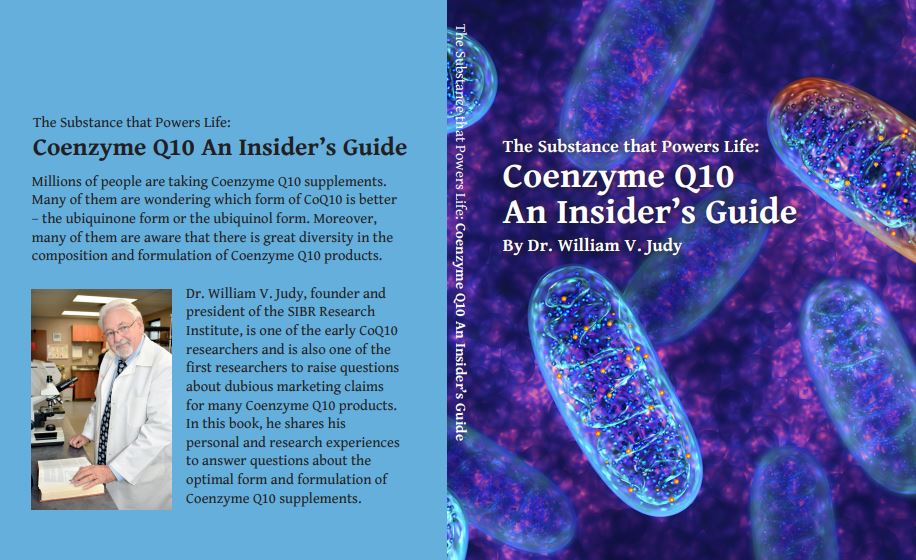
Why is the important vitamin-like substance Coenzyme Q10 not easily absorbed from supplements? In his book Coenzyme Q10: The Substance That Powers Life, the renowned CoQ10 researcher Dr. William Judy explained why the absorption of CoQ10 from food and supplements is difficult.
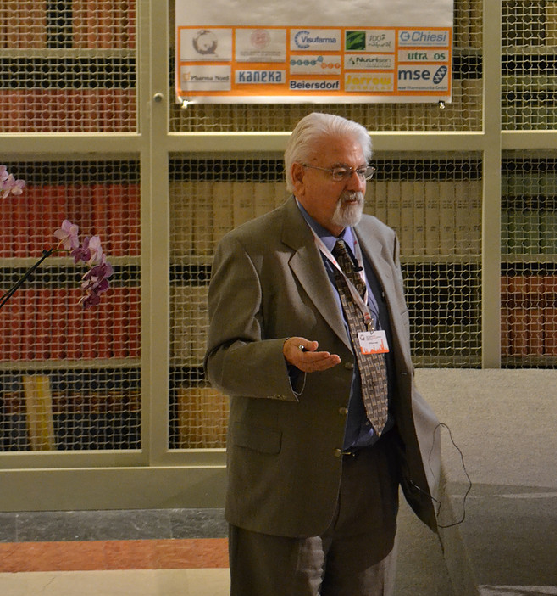
Dr. William V. Judy, 1938-2022, was a physiologist, bio-physicist, and clinical researcher. He was an expert in Coenzyme Q10 and cardiovascular health.
What are the properties that limit CoQ10 absorption? On pages 48-50 of his book, Dr. Judy made the following points:
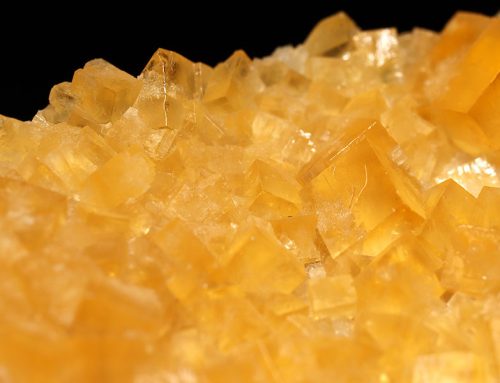
- The CoQ10 raw material is crystalline. Humans cannot absorb these crystals. The supplement manufacturer must find a crystal dispersion process to deliver dissolved CoQ10 molecules to the gastrointestinal tract. Note that the temperature at which CoQ10 will dissolve naturally is much higher than human body temperature.
- The CoQ10 molecules are lipid-soluble. By themselves, they will have much difficulty navigating the aqueous environment of the small intestines. The CoQ10 molecules enter the small intestines as part of the gastric chyme coming from the stomach. They will need to be solubilized into mixed micelles to be transported to the enterocytes (intestinal absorption cells). Note that the CoQ10 molecules themselves cannot be made “water-soluble” and retain their CoQ10 properties – claims to the contrary are misleading.
- The CoQ10 molecules are quite large. They are too large to be absorbed directly into the blood from the small intestines. Following uptake by the intestinal absorption cells, the CoQ10 molecules are packaged into (incorporated into) chylomicrons for transport into the lymphatic system. The chylomicrons transport the CoQ10 through the lymphatic system and enter the blood circulation through the thoracic duct.
Why are the Bile Salts Important to CoQ10 Absorption?
In the small intestines, our bodies use bile salts to accomplish the absorption of dietary fat. Where do the bile salts come from?
The process starts with the liver making bile acids from cholesterol. The resulting bile is stored in the gallbladder. The bile consists of bile salts, bilirubin, cholesterol, phospholipids, and water. The gall bladder stores the bile between meals, removes the water, and up-concentrates the bile salts in the bile.
When we eat fat, the gallbladder releases bile. The bile salts surround the globules of fat and fat-soluble substances like CoQ10. In a process called emulsification, the bile salts break down large fat globules into tiny droplets.
The bile salts combine with cholesterol, fat-soluble vitamins, fatty acids, monoglycerides, phospholipids, and CoQ10 molecules to form mixed micelles. These micelles have hydrophobic cores and hydrophilic exteriors that enable them to remain suspended in the aqueous intestinal content. Without the bile salts and without the formation of micelles, the CoQ10 molecules would not be able to move toward the intestinal absorption cells.
When the mixed micelles arrive at the membrane surface of the intestinal absorption cells, the CoQ10 and the other fatty substances leave the micelles and are taken up by the intestinal absorption cells.
Why Should We Take CoQ10 Supplements Together with a Meal?
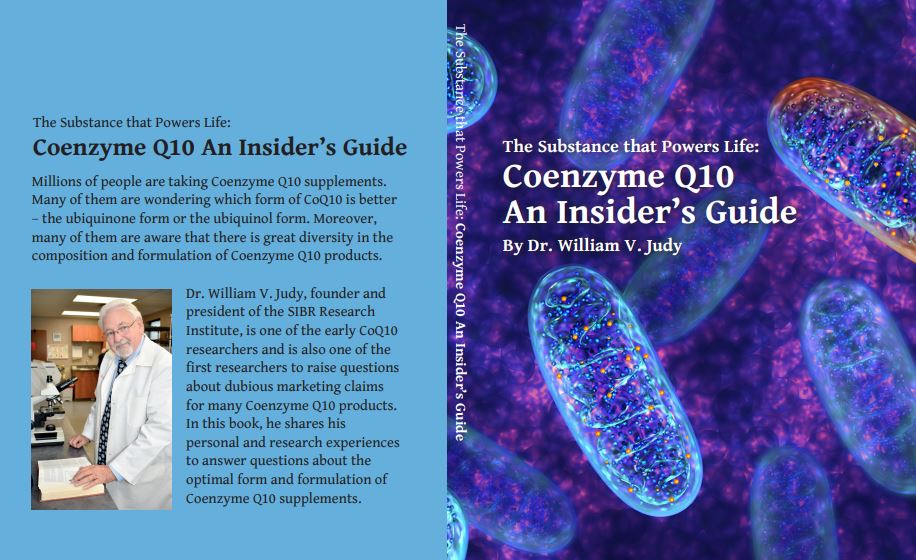
The book Coenzyme Q10: The Substance That Powers Life is good place to learn more about CoQ10. The book is available from amazon.com. The ISBN is 978-87-7776-187-7.
The absorption of CoQ10 (and fat-soluble vitamins like the vitamins D, E, and K) depends upon the release of bile from the gall bladder. It is the presence of fat that results in the release of bile.
Accordingly, Dr. Judy advised taking a CoQ10 supplement together with a meal containing some fat [Judy 2018, p. 49]. He preferred a CoQ10 supplement formulation that contained lipid carriers for the CoQ10.
Moreover, Dr. Judy recommended taking CoQ10 supplements in divided doses at meal times. He pointed out that taking 100 mg at breakfast and 100 mg at lunch will give better absorption than taking 200 mg all at once at breakfast or at lunch [Judy 2018, p. 47].
Is the CoQ10 Supplement Formulation More Important than the CoQ10 Form?
The answer from Dr. Judy is an emphatic yes. The supplement manufacturer needs three things to make an absorbable CoQ10 preparation [Judy 2018, p. 50]:
- a CoQ10 crystal dispersion process that dissolves the CoQ10 crystals to single molecules
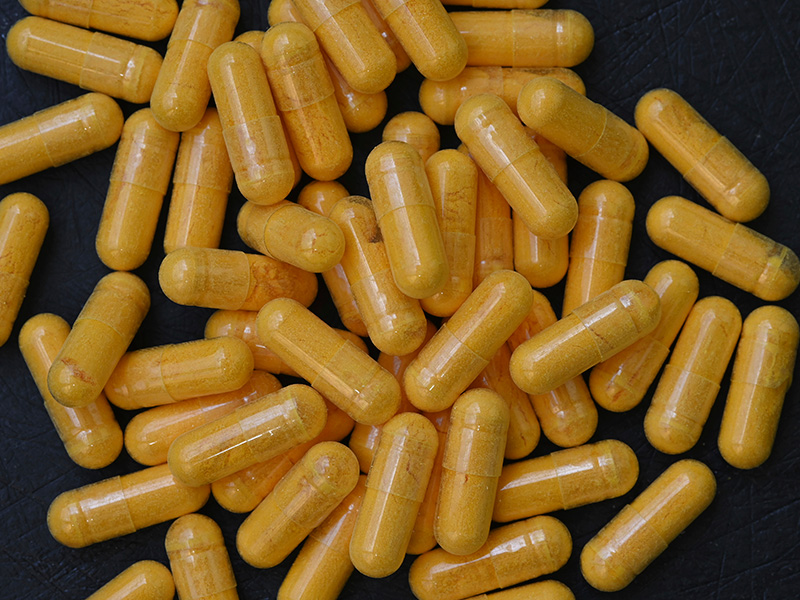
- a stable formulation that prevents the re-crystallization of the CoQ10 inside the capsules
- carrier oils that enhance the absorption of the CoQ10
Which Clinical Trial Demonstrated the Importance of the CoQ10 Formulation?
In a 2019 double-blind cross-over study by Prof. Guillermo López-Lluch and colleagues, the researchers compared the absorption of seven different CoQ10 supplement formulations. They measured plasma CoQ10 concentrations over 48 hours after a single 100-mg dose. They used 4-week washout periods between the individual tests. They found significant differences between the formulations: soft-gel capsules with properly dissolved ubiquinone, i.e., completely dispersed crystals, showed the best absorption. The absorption of the best formulation ubiquinone preparation was nearly double the absorption of a ubiquinol preparation. Prof. Lopez-Lluch and the research team noted considerable individual variation in CoQ10 absorption [Lopez-Lluch 2019]. That is why studies to compare the bioavailability of different CoQ10 products should be carried out in the same set of individuals.
What Are Misleading Claims for Ubiquinol Supplements?
In a 2021 journal article, Dr. Judy explained the misleading nature of several claims for ubiquinol supplements [Judy 2021]:
Claim: Superior ubiquinol absorption
The evidence from the Lopez-Lluch comparative study disproves this misleading claim. The point remains that the formulation of the CoQ10 supplement, i.e., one with complete crystal dispersion, is more important to absorption than whether the supplementary CoQ10 is in the form of ubiquinol or ubiquinone [Lopez-Lluch 2019; Mantle & Dybring 2020].
Claim: Ubiquinol Supplement Needed to Increase Plasma Ubiquinol Concentrations
In a 2020 journal article, Mantle & Dybring showed that five enzyme systems exist in the humans to convert ubiquinone (both endogenous and exogenous) to ubiquinol as needed. It is not necessary to take a ubiquinol supplement to get enough ubiquinol.
Claim: People Older Than Age 40 Years Need Ubiquinol
This claim is not substantiated. It is refuted by the significant health benefits of ubiquinone supplementation in the following clinical trials:
Q-Symbio study: CoQ10 adjuvant treatment in patients with chronic heart failure, mean age 63 years
KiSel-10 study: supplementation in senior citizens, mean age 78 years
Morisco study: CoQ10 adjuvant treatment in patients with congestive heart failure, mean age 67 years
Conclusions: CoQ10 Absorption Depends Upon the Supplement Formulation
The absorption and bioavailability of commercially available CoQ10 supplements varies considerably from one product to another.
It is important to buy a CoQ10 supplement with scientifically documented absorption. Anything else is a waste of money.
The form of the CoQ10 supplement – ubiquinol or ubiquinone – is much less important for absorption than is the proper formulation of the supplement (crystal dispersion status).
Sources
Alehagen U, Johansson P, Björnstedt M, Rosén A, Dahlström U. Cardiovascular mortality and N-terminal-proBNP reduced after combined selenium and coenzyme Q10 supplementation: a 5-year prospective randomized double-blind placebo-controlled trial among elderly Swedish citizens. Int J Cardiol. 2013;167(5):1860-1866.
Judy WV. Coenzyme Q10: The Substance That Powers Life, An Insider’s Guide. 2018. ISBN: 978-87-7776-186-7. Available from amazon.com.
Judy WV. The Instability of the lipid-soluble antioxidant ubiquinol: Part 3-Misleading marketing claims. Integr Med (Encinitas). 2021 Dec;20(6):24-28.
López-Lluch G, Del Pozo-Cruz J, Sánchez-Cuesta A, Cortés-Rodríguez AB, Navas P. Bioavailability of coenzyme Q10 supplements depends on carrier lipids and solubilization. Nutrition. 2019 Jan;57:133-140.
Mantle D, Dybring A. Bioavailability of coenzyme Q10: an overview of the absorption process and subsequent metabolism. Antioxidants (Basel). 2020 May 5;9(5):386.
Morisco C, Trimarco B, Condorelli M. Effect of Coenzyme Q10 therapy in patients with congestive heart failure: a long-term multi-center randomized study. Clin Investigator. 1993;71:S134-S136.
Mortensen SA & Q-Symbio Study Investigators. The effect of coenzyme Q10 on morbidity and mortality in chronic heart failure: results from Q-SYMBIO: a randomized double-blind trial. JACC Heart Fail. 20142(6):641-649.
The information presented in this review article is not intended as medical advice. It should not be used as such.

Leave A Comment