

What is Coenzyme Q10 (CoQ10)?
CoQ10 is a substance that helps the body produce energy. It is somewhat like a vitamin because it plays an important role in how the body works. However, it isn’t technically a vitamin because our cells can and do synthesize it themselves [Saini 2011].
How do the cells synthesize CoQ10?
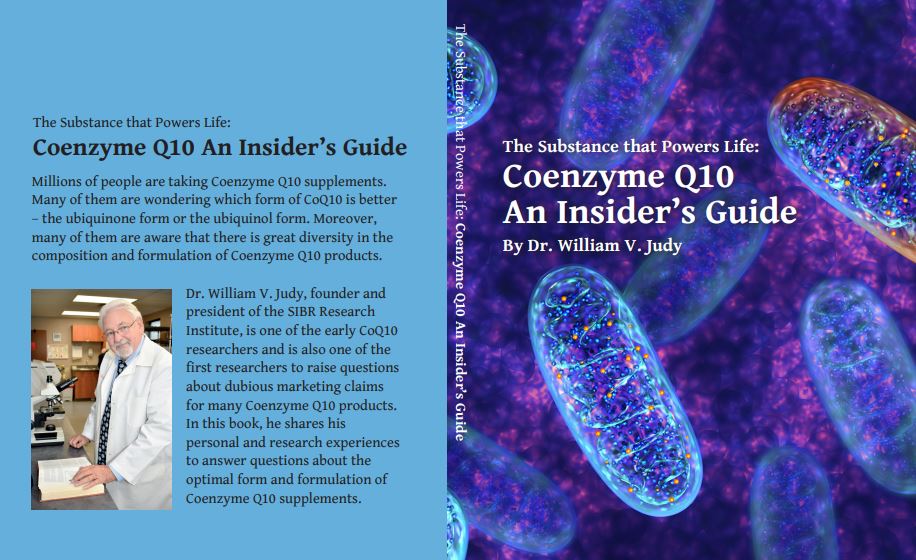
Dr. William Judy’s book, Coenzyme Q10: An Insider’s Guide, remains the best available overview of the efficacy and safety of Coenzyme Q10. ISBN: 978-87-7776-186-7. Available from amazon.com.
Making CoQ10 is a complex process that involves at least 13 different genes and requires several substances, including the amino acid tyrosine, various B vitamins, trace minerals, and other helper substances called cofactors. If the body is lacking one or more of these nutrients, it will produce less CoQ10. The cells themselves make most of the CoQ10 that the body needs until, with increasing age, they make less and less. The CoQ10 molecules have two main parts [Mantle 2018].
How do the head and the tail of the CoQ10 molecule take form?
- The CoQ10 molecule consists of a ring-shaped head called a quinone ring. Attached to one end of this ring is a long side chain made up of 10 isoprene units.
- The quinone “head” that gives CoQ10 its ability to take up and give away electrons. This part of the CoQ10 molecule is made in a structure inside our cells called the endoplasmic reticulum.
- The isoprene “tail” makes CoQ10 lipid-soluble (able to dissolve in fats). This part is made through a series of chemical reactions known as the mevalonate pathway.
How do the head and the tail of the CoQ10 molecule fit together?
- The head and the tail are then joined together to make the complete CoQ10 molecule. This happens in an enzyme complex called Complex Q, which is located on the inner membrane of the mitochondria.
- Because the CoQ10 molecule is relatively large – about 5.5 nanometers long and 864 times heavier than a hydrogen atom – it is not easily absorbed by the body.
Why is CoQ10 important for good health?
CoQ10 is essential in the cellular process of ATP energy generation. Thus, it works inside tiny structures in the cells called mitochondria. Some scientists describe the mitochondria as the “power plants” of the cells.
CoQ10 helps move electrons through a process that ultimately produces ATP, the main form of energy that cells use to function. This energy-producing process is called oxidative phosphorylation. Logically, the organs that need the most energy tend to contain the most CoQ10. These include the heart, kidneys, and liver [Saini 2011].
Because it dissolves in fat, CoQ10 can protect the membranes around our cells and can protect certain fats in the blood from damage caused by harmful free radicals. CoQ10 is the only fat-soluble antioxidant that the body produces itself. It helps prevent a process called lipid peroxidation, in which free radicals damage fats in cell membranes, proteins, and DNA [Mantle 2022].
How do CoQ10 molecules get absorbed?
The relatively large size and the fat-solubility of CoQ10 molecules make absorption difficult. That CoQ10 is fat-soluble means that it does not dissolve well in the watery environment of the digestive tract or blood. Moreover, its relatively large, oily structure means it does not pass to and through the intestinal wall on its own. Instead, dietary and supplementary CoQ10 is incorporated into tiny fat droplets called mixed micelles. The micelles help transport the CoQ10 to the surface of intestinal cells [Judy 2018].
Once the CoQ10 is released from the micelles and enters the intestinal cells, it is packaged into particles called chylomicrons. These particles first enter the lymphatic system and then eventually enter the bloodstream. CoQ10 usually peaks in the blood 5 – 8 hours following oral ingestion. It has a half-life of ca. 33 hours [Judy 2018].
What is normal CoQ10 status in the blood?
The body makes CoQ10 in almost all cells, except red blood cells. Accordingly, CoQ10 is found in the cell membranes throughout the body. The normal level of CoQ10 in the blood varies somewhat; it is usually around 0.7–1.4 mg/L.
The body’s ability to make CoQ10 is at its highest in an individual’s early to mid-20s. After that, CoQ10 production gradually decreases as humans get older. However, the decrease is different in different organs [Kalén 1989].
- At age 80, the liver may have about 83% of its earlier highest CoQ10 level.
- At age 80, the heart may have about 43% of its earlier highest CoQ10 level.
What is optimal CoQ10 status in the blood?
Optimal blood CoQ10 status for adjuvant treatment for heart failure requires a CoQ10 level in the blood (plasma) of more than 2.5 mg/L. For adjuvant treatment of neurodegenerative diseases – diseases that affect the nervous system, such as some forms of dementia or Parkinson’s disease – blood CoQ10 level of more than 3.5 mg/L may be necessary [Langsjoen 2014].
It takes a couple of weeks of regular CoQ10 intake for the level in the blood to reach a stable level. Scientists call this stable level the pharmacological steady state. It seems unlikely that raising the blood (plasma) concentration of CoQ10 above 4.0 mg/L will yield further health benefits.
What are the most important studies of CoQ10 supplementation?
What was the Q-Symbio Study?
The Q-SYMBIO randomized controlled trial enrolled 420 patients with moderate-to-severe chronic heart failure. The study participants received 300 mg/day of CoQ10 or placebo alongside standard heart failure treatment for two years. Major adverse cardiovascular events, cardiovascular mortality, all-cause mortality, and heart-failure hospitalizations were all significantly lower in the adjuvant CoQ10 group compared to the placebo group [Mortensen 2014].
What was the KiSel-10 Study?
The KiSel-10 randomized controlled trial involved 443 elderly Swedish participants aged 70–88 years. For four years, the study participants received 200 mcg/day selenium plus 200 mg/day CoQ10 or matching placebos. The researchers’ analysis associated the combined supplementation with significantly lower cardiovascular mortality, reduced NT-proBNP blood levels, and improved echocardiographic measures of cardiac function. The findings suggested potential cardiovascular benefits in older adults with relatively low selenium status [Alehagen 2013].
How safe is supplementary CoQ10?
Hidaka et al. reviewed human and animal safety data. They concluded that CoQ10 has low toxicity and does not appear to cause any serious adverse effects in humans. Their risk assessment identified an observed safe level of 1,200 mg/day. Overall, the evidence supported a high safety margin for oral CoQ10 supplementation [Hidaka 2008].
In 2024, a meta-analysis of 33 randomized controlled trials in heart failure reported no major adverse effects associated with CoQ10 [Xu 2024].
Conclusion: Supplementary CoQ10 safe, affordable, effective
First of all, supplemental CoQ10 is generally well tolerated. Safety studies report no serious adverse effects.
Secondly, adjuvant CoQ10 treatment confers significant health benefits in heart failure and some cardiovascular outcomes. Three times 100 mg/day CoQ10 supplementation improved symptoms and survival in chronic heart failure patients.
Thirdly, not all CoQ10 supplements are equally effective. It is important to purchase a product with well-documented absorption and bioavailability.
Primary Sources
Alehagen U, Johansson P, Björnstedt M, Rosén A, Dahlström U. Cardiovascular mortality and N-terminal-proBNP reduced after combined selenium and coenzyme Q10 supplementation: a 5-year prospective randomized double-blind placebo-controlled trial among elderly Swedish citizens. Int J Cardiol. 2013 Sep 1;167(5):1860-6.
Kalen, A, et al. Age related changes in lipid composition of rat and human tissues. Lipids 1989, 24, 579–84.
Langsjoen PH, Langsjoen AM. Comparison study of plasma coenzyme Q10 levels in healthy subjects supplemented with ubiquinol versus ubiquinone. Clin Pharmacol Drug Dev. 2014 Jan;3(1):13-7.
López‐Lluch, G.; Del Pozo‐Cruz, J.; Sánchez‐Cuesta, A.; Cortés‐Rodríguez, A.B.; Navas, P. Bioavailability of coenzyme Q10 supplements depends on carrier lipids and solubilization. Nutrition 2019, 57, 133–140.
Mohr, D, et al. Dietary supplementation with coenzyme Q10 results in increased levels of ubiquinol‐10 within circulating lipoproteins and increased resistance of human low‐density lipoprotein to the initiation of lipid peroxidation. Biochim. Biophys. Acta (BBA) Lipids Lipid Metab. 1992, 1126, 247–54.
Mortensen SA, Rosenfeldt F, Kumar A, Dolliner P, Filipiak KJ, Pella D, Alehagen U, Steurer G, Littarru GP; Q-SYMBIO Study Investigators. The effect of coenzyme Q10 on morbidity and mortality in chronic heart failure: results from Q-SYMBIO: a randomized double-blind trial. JACC Heart Fail. 2014 Dec;2(6):641-9.
Secondary Sources
Hidaka T, Fujii K, Funahashi I, Fukutomi N, Hosoe K. Safety assessment of coenzyme Q10 (CoQ10). Biofactors. 2008;32(1-4):199-208.
Judy, William V. The Substance That Powers Life: Coenzyme Q10, An Insider’s Guide. 2018. ISBN 978-87-7776-186-7. Available from amazon.com.
Mantle, D. Hargreaves IP. Ataxia and coenzyme Q10: An overview. Brit. J. Neurosci. Nurs. 2018, 14, 108–14.
Mantle D, et al. Bioavailability of Coenzyme Q10: An overview of the absorption process and subsequent metabolism. Antioxidants (Basel). 2020 May 5;9(5):386.
Mantle D, Turton N, Hargreaves IP. Depletion and supplementation of Coenzyme Q10 in secondary deficiency disorders. Front Biosci (Landmark Ed). 2022 Dec 19;27(12):322.
Saini R. Coenzyme Q10: The essential nutrient. J Pharm Bioallied Sci. 2011 Jul;3(3):466-7.
Xu J, Xiang L, Yin X, Song H, Chen C, Yang B, Ye H, Gu Z. Efficacy and safety of coenzyme Q10 in heart failure: a meta-analysis of randomized controlled trials. BMC Cardiovasc Disord. 2024 Oct 26;24(1):592.
The information presented in this review article is not medical advice. Readers should not use this information as medical advice.











Leave A Comment