

What is the rationale for the use of Coenzyme Q10 (CoQ10) in the treatment of cardiovascular diseases? Worldwide, cardiovascular diseases are the number one cause of death. Mitochondrial dysfunction, oxidative stress, and inflammation are key factors in atherosclerosis, heart failure, hypertension, and endothelial dysfunction. Low CoQ10 status contributes to reduced energy generation in the heart muscle and to impaired vascular function. Accordingly, the use of CoQ10 supplements as an adjuvant therapy can improve cardiovascular disease outcomes [Rabanal-Ruiz 2021; Mantle 2015].

Cardiovascular diseases are the leading cause of death globally. Adjuvant Coenzyme Q10 treatment can improve symptoms and survival chances.
How does CoQ10 protect against worsening heart disease? The heart muscle needs energy. CoQ10 plays a central role in mitochondrial ATP energy production. CoQ10 also acts as a powerful lipid-soluble antioxidant protecting against oxidative damage in the heart and blood vessels. In addition, CoQ10 has anti-inflammatory action, for example by inhibiting the activation of nuclear factor kappa B (NfκB), the “master switch” controlling the inflammatory process. CoQ10 is needed to maintain endothelial health and vasodilation. All these CoQ10 functions benefit good heart function [Rabanal-Ruiz 2021; Mantle 2015].
Note: The endothelium is the thin inner lining of the blood vessels. The endothelium regulates blood flow, clotting, and inflammation. Healthy endothelial cells promote smooth blood flow. Endothelial dysfunction is an indicator of cardiovascular disease risk.
Who Needs Coenzyme Q10 Supplementation?
CoQ10 is a vitamin-like substance. It is not designated as a vitamin because we humans synthesize it endogenously. However, its production levels decline with increasing age as we progress into our 30s and 40s and beyond. Moreover, statin medications that inhibit the body’s production of cholesterol also inhibit the body’s production of CoQ10. Especially vulnerable to cardiovascular dysfunction because of the reduced biosynthesis of CoQ10 are the following groups of individuals [Rabanal-Ruiz 2021]:
- Elderly individuals
- Individuals with type 2 diabetes
- Individuals with heart failure
- Individuals with hypertension
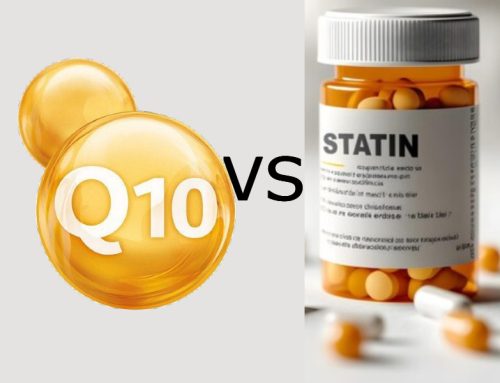
- Individuals taking statin medications
- Individuals with chronic kidney disease
- Individuals with non-alcoholic fatty liver disease (NAFLD)
What is the Recommended Daily Dose of CoQ10?
In their review article, Rabanal-Ruiz et al present clinical evidence that CoQ10 supplementation at doses of 200 – 300 mg/day for prolonged periods is safe and well-tolerated. This daily dosage should significantly increase the plasma CoQ10 concentration. It should help to reduce the level of oxidative stress and the risk of cardiovascular disease mortality.
What is the Clinical Evidence for Supplementary CoQ10?
What Effect Does Adjuvant CoQ10 Treatment Have in Heart Failure?
In the two-year randomized controlled Q-Symbio trial, the administration of 3 times 100 mg CoQ10 daily to chronic heart failure patients had the following significant outcomes compared to placebo [Mortensen 2014]:
- increased plasma CoQ10 levels
- reduced major adverse cardiovascular events
- reduced cardiovascular and all-cause mortality
Does CoQ10 Help in Coronary Artery Disease and Cardiac Surgery?
Supplementary CoQ10 at 200 or 300 mg/day for 7–14 days before heart surgery and for 30 days after heart surgery can benefit patients undergoing coronary and cardiac surgeries [Rosenfeldt 2005; Judy 1993].
What is CoQ10’s Role in Hypertension and Endothelial Dysfunction?
Clinical evidence suggests that CoQ10 can lower blood pressure modestly and improve measures of endothelial function by increasing nitric oxide bioavailability and reducing levels of reactive oxygen free radical species (ROS), the cause of oxidative stress. These effects help counter arterial stiffness and improve flow-mediated dilation — important factors in vascular health [Rabanal-Ruiz 2021].
Does CoQ10 Protect Against Atherosclerosis?
Oxidation of LDL particles is a key step in atherogenesis: the formation of plaque on the inner walls of arteries leading to atherosclerosis. CoQ10 functions as an antioxidant to inhibit the oxidation of LDL particles and to limit the extent of oxidative stress in the blood vessels [Rabanal-Ruiz 2021].
Is CoQ10 Safe and Well-tolerated?
Based on their review of the clinical evidence, Rabanal-Ruiz et al [2021] assert that CoQ10 supplementation at doses of 200 mg/day or higher for prolonged periods is safe and well-tolerated. Supplementation with 200-300 mg/day can significantly increase the CoQ10 concentration in plasma. Supplementary CoQ10 treatment is associated with reduced levels of oxidative stress and reduced mortality from cardiovascular causes.
Conclusions: CoQ10 Supplementation and Cardiovascular Disease?
Rabanal-Ruiz et al [2021] show that supplementary CoQ10 has several biological mechanisms that are relevant to cardiovascular health.
Rabanal-Ruiz et al [2021] cite clinical data that supports beneficial effects of supplementary CoQ10 on heart function, oxidative stress, inflammation, endothelial health, and survival.
Are all commercially available CoQ10 supplements equally good? In a word, no. There is considerable variation in the absorption and bioavailability of CoQ10 supplements [Mantle 2015; Mantle & Dybring 2020].
It is important to select a CoQ10 supplement produced to pharmacological standards, with scientifically documented absorption and efficacy. To do otherwise would be a waste of money.
Sources
Judy WV et al. Myocardial preservation by therapy with coenzyme Q10 during heart surgery. Clin Investig. 1993;71(8 Suppl):S155-61.
Mantle D. Coenzyme Q10 and cardiovascular disease: an overview. Br J Cardiol. 2015;22:160.
Mantle D, Dybring A. Bioavailability of Coenzyme Q10: An overview of the absorption process and subsequent metabolism. Antioxidants (Basel). 2020 May 5;9(5):386.
Mortensen SA et al. The effect of coenzyme Q10 on morbidity and mortality in chronic heart failure: results from Q-SYMBIO: a randomized double-blind trial. JACC Heart Fail. 2014 Dec;2(6):641-9.
Rabanal-Ruiz Y et al. The Use of Coenzyme Q10 in cardiovascular diseases. Antioxidants (Basel). 2021 May 10;10(5):755.
Rosenfeldt F. Coenzyme Q10 therapy before cardiac surgery improves mitochondrial function and in vitro contractility of myocardial tissue. J Thorac Cardiovasc Surg. 2005 Jan;129(1):25-32.
The information presented in this review article is not intended as medical advice. It should not be used as such.








Leave A Comment